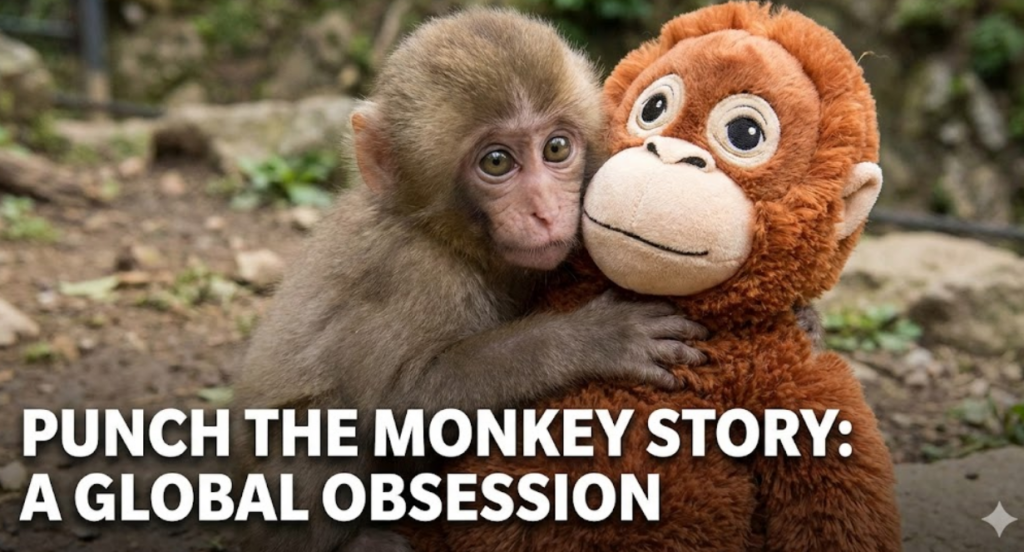
In an era where the internet is often defined by fleeting trends and cynical humor, the world recently ground to a halt to collectively cry over a baby animal in Japan. If you have logged onto any social media platform recently, you have likely seen the images: a tiny, wide-eyed primate fiercely clutching a plush orangutan toy that is almost bigger than he is.
But who is punch the monkey, and how did he become a global obsession?
For millions of people searching for what is the punch monkey story, the tale of this resilient little primate is a devastatingly beautiful look at maternal abandonment, animal psychology, and the universal need for comfort. This comprehensive deep-dive explores what happened to punch the monkey, the truth behind those heartbreaking viral videos, the psychology of his surrogate plush toy, and how the internet banded together to cheer for his survival punch the monkey story
The Origins: What Happened to Punch the Monkey?
To understand what is the story of punch monkey, we have to go back to his birth. Punch (affectionately known locally as Punch-kun) is a Japanese macaque born on July 26, 2025, at the Ichikawa City Zoo and Botanical Garden, located just outside of Tokyo, Japan.
In macaque societies, the bond between mother and infant is absolute. Baby Japanese macaques instinctively cling to their mother’s abdomen immediately after birth. This crucial physical contact builds the infant’s muscle strength, provides warmth, and offers a deep sense of psychological security. Furthermore, a macaque’s status in the troop’s strict matrilineal hierarchy is entirely dictated by its mother.
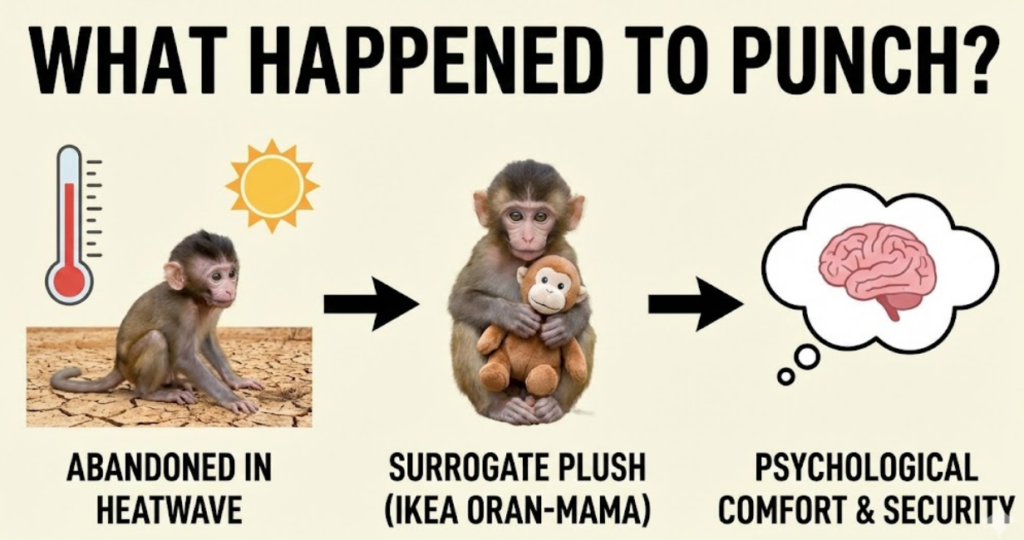
Tragically, shortly after he was born during an intense Japanese heatwave, Punch was abandoned by his mother. Primatology experts, such as Alison Behie from the Australian National University, note that while abandonment is rare, it does happen. It is often triggered by the mother being inexperienced (a first-time mother), underlying health issues, or severe environmental stress. In extreme heat, a mother may instinctively prioritize her own survival over a vulnerable infant.
Without a mother to protect him or teach him the complex social etiquette of the punch the monkey zoo enclosure, Punch was completely isolated. Zoo staff immediately stepped in to hand-rear the infant, bottle-feeding him to ensure his physical survival. However, they soon realized that keeping a baby macaque physically alive was only half the battle; the emotional and psychological toll of isolation was setting in.
The Surrogate Mother: The Psychology of the Orangutan Plush
Because Punch had no mother to hold onto, he lacked the critical “contact comfort” necessary for normal primate brain development. Zookeepers initially tried giving him rolled-up towels to mimic the feeling of clinging to a mother’s fur, but it wasn’t enough.
In a stroke of empathetic brilliance, the staff introduced him to an IKEA DJUNGELSKOG orangutan plush toy. Punch instantly bonded with it. The punch the monkey toy became his entire world. He slept with it, dragged it across the dirt, buried his face in it when he was scared, and used it as an emotional shield. Fans online quickly dubbed the toy “Ora-mama.”
This heartbreaking image of baby punch clinging to his plushie perfectly mirrors one of the most famous (and controversial) psychological studies in history: Harry Harlow’s 1950s attachment experiments. Harlow separated infant macaques from their mothers and offered them two artificial surrogates—a cold wire mother that provided milk, and a soft cloth mother that provided no food. The infants overwhelmingly chose to spend their time clinging to the soft cloth mother, proving that tactile comfort is a biological necessity for primates, sometimes outweighing even the drive for food.
The punch monkey toy wasn’t just a cute photo op; it was literally keeping his psyche intact.
The Viral Videos and Internet Panic: Did Punch the Monkey Die?
When the zoo began slowly integrating Punch into the main troop’s enclosure at Monkey Mountain, disaster seemed to strike. The internet was soon flooded with a highly distressing punch the monkey video showing the tiny infant being swatted, pushed, and violently dragged in circles by much larger, older macaques. Every time he was attacked, he would scramble away to hide behind a rock, desperately clutching his plush toy.
The outrage and heartbreak online were instantaneous. Millions of viewers watched the punch the baby monkey videos, leading to widespread panic and outrage directed at the zoo. Rumors began to swirl wildly. Search engines were flooded with frantic queries like is punch the monkey dead and did punch the monkey die.
To set the record straight: No, Punch is not dead. He is alive, growing, and physically healthy.
While viewers interpreted the footage as malicious, human-style bullying, primatologists gently corrected this misconception. Japanese macaques live in rigid, dominance-based hierarchies. What looked like bullying was actually normal social interaction and dominance assertion. Normally, a baby’s mother would intervene to protect her infant and teach him the proper submissive gestures to appease the older monkeys. Because Punch lacked a mother to teach him these social cues (like avoiding direct eye contact with dominant males), he inadvertently provoked the troop.
Despite the rough treatment, zookeepers assured the public that no monkey showed intent to seriously injure him. Punch was simply learning the harsh realities of macaque etiquette the hard way.
The Turning Point: Punch Monkey Accepted
Just as the internet’s collective heartbreak reached a fever pitch, a highly anticipated punch the monkey update brought tears of relief to millions.
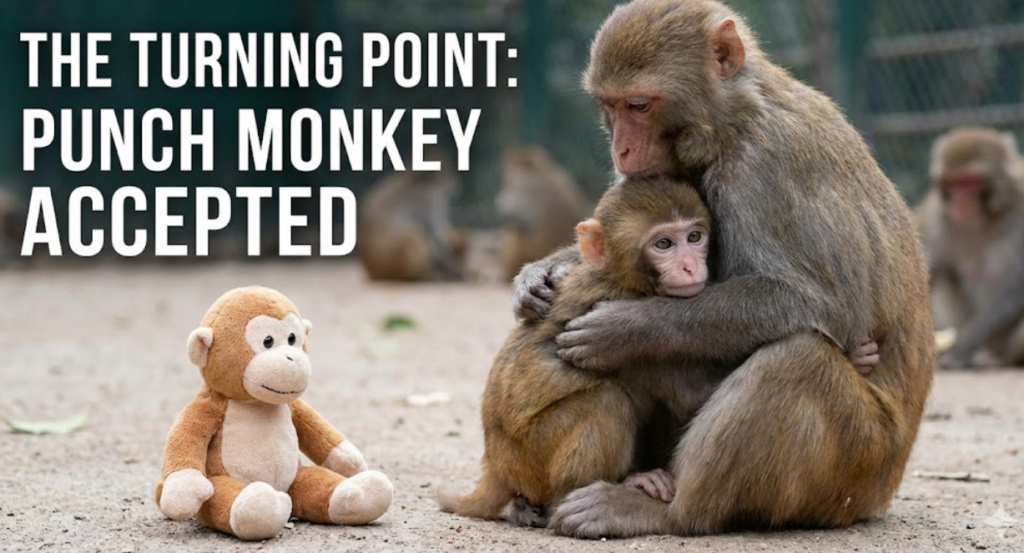
Late in February 2026, visitors and zookeepers captured a monumental breakthrough: punch monkey accepted by a member of the troop. Footage emerged of an adult female macaque named Onsing approaching Punch. Instead of swatting him, she gently drew him into a warm embrace and began to groom him.
In the primate world, grooming is not just about hygiene; it is a complex social language. It is the ultimate sign of trust, bonding, and acceptance into the hierarchy. Since that first embrace, Punch has been seen steadily integrating into the group. He is playing with other young monkeys, learning how to appropriately interact, and occasionally even leaving his beloved IKEA toy on the other side of the enclosure while he explores.
While the road ahead is still long, the punch monkey story is shifting from a tragedy to a triumphant tale of resilience.
The Global Phenomenon and the IKEA Craze
The viral nature of the story of punch the monkey had massive real-world consequences, particularly in the retail sector. As millions of people fell in love with Punch, they also fell in love with his plush companion.
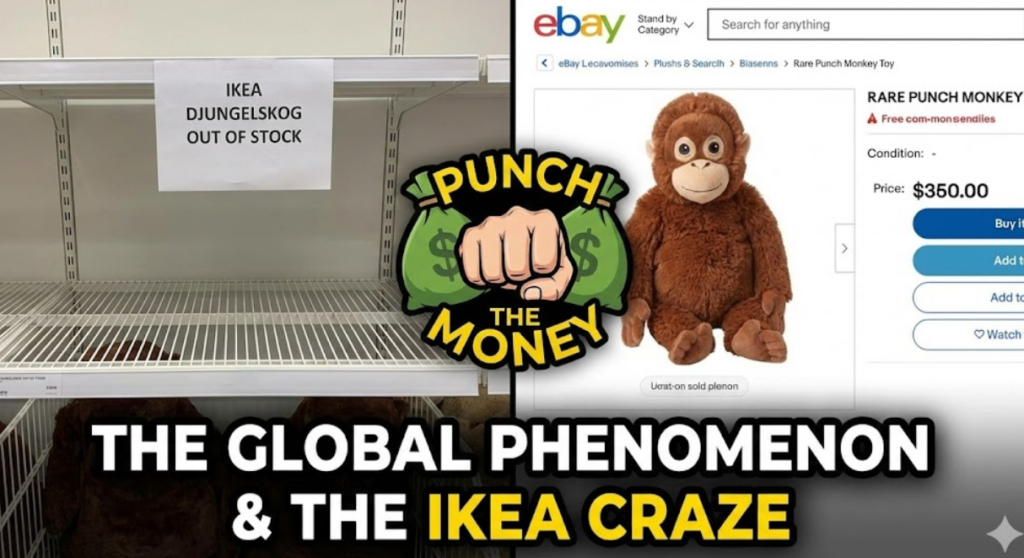
The $20 IKEA DJUNGELSKOG orangutan toy sold out almost immediately across the United States, Japan, South Korea, and Australia. Desperate fans wanting to own a piece of the punch the monkey ikea phenomenon inadvertently sparked an aggressive secondary market. Scalpers began hoarding the toys, attempting to essentially punch the money out of sympathetic buyers by reselling the $20 plushies on eBay for as much as $51 to $350.
Recognizing the cultural moment, Petra Fare, the President and Chief Sustainability Officer of IKEA Japan, personally visited the Ichikawa City Zoo. She donated a mountain of replacement DJUNGELSKOG toys to ensure that Punch would never be without his “Oran-mama” if his original toy became worn or torn.
The Bizarre Algorithm: How Punch Took Over the Internet
To truly understand the scale of the punch the monkey story, you have to look at how it completely hijacked the algorithms of platforms like X (formerly Twitter), TikTok, and Instagram in early 2026. The algorithm created a surreal, chaotic collage of human interests, blending serious news, sports, and pop culture with the tears of a baby macaque.
One moment, users might be refreshing their feeds for sports scores like psg vs monaco, juventus vs galatasaray, or atalanta vs dortmund. The next moment, they were weeping over Punch. It didn’t matter if teenagers were frantically searching for a leaked cbse class 10th science question paper, or adults were researching medical information like the hpv vaccination—the algorithm inevitably fed them videos of the lonely monkey.
The cultural cross-pollination was staggering. Entertainment fans found their timelines completely hijacked. People anxiously awaiting updates on bridgerton season 4 part 2 or the gritty crime drama the penguin found themselves far more invested in a real-life zoo enclosure. Whether you were streaming the soulful ballads of singer arijit singh, watching intense monologues by Bollywood veteran nana patekar, or catching up on indie films like the bluff, Punch was inescapable.
Internet culture reacted the only way it knows how: through intense, hyperbolic emotion and memes. Marvel fans compared the emotional devastation of seeing Punch bullied to the trauma of the thanos snap executed by the villain thanos. Users felt as unhinged as the character ross geller from Friends screaming about his stolen Thanksgiving sandwich. Some users jokingly demanded that WWE superstar john cena be airdropped into the zoo to body-slam the older macaques. Anime fans even made highly edited tribute videos, dubbing him punch the monkey jjk in reference to the epic battles of Jujutsu Kaisen.
The sheer volume of traffic caused search anomalies. People looking up sports stats for cricketers like auqib nabi and annerie dercksen were derailed. Users trying to trigger classic Google Easter eggs by typing do a barrel roll or google gravity were met with cascading heart animations dedicated to Punch.
Even offshoot typos and bizarre adjacent searches spiked globally. People searching for an existential nihilist penguin, watching a regular penguin documentary, looking up the numerology of the number 67, or typing frantic typos like lunch the monkey, pinch the monkey, punch the moneky, and even punch the dog, all found themselves miraculously redirected to the Ichikawa City Zoo. The internet had spoken: nothing mattered more than Punch.
The Ethical Debate: Cuteness vs. Conservation
While what is the punch monkey story represents a heartwarming internet moment, it has also sparked serious conversations among animal welfare advocates.
Organizations like PETA have argued that the viral images of Punch clinging to a stuffed toy should not be romanticized as “cute,” but rather viewed as a glaring indicator of severe psychological stress and social deprivation. They argue that it highlights the inherent cruelty of keeping highly social primates in enclosed zoo environments.
Conversely, conservation psychologists like Carla Litchfield argue that Punch’s story is a vital educational tool. It brings unprecedented global attention to the impacts of climate change (such as the heatwave that likely caused his mother’s stress), habitat loss, and the incredible complexity of animal emotions.
Zoo officials have remained transparent throughout the ordeal. They have enforced stricter barriers around Punch’s enclosure to manage the massive influx of tourists and maintain a quiet, stress-free environment for the troop. Their ultimate goal is for Punch to grow up as a normal, healthy macaque who no longer needs a plush toy to feel safe in the world.
Conclusion: Why We Care
Ultimately, the phenomenon of Punch the monkey transcends borders, languages, and cultures. In an online world often dominated by bad news, political division, and cynicism, the sight of a tiny, vulnerable creature seeking comfort in a stuffed animal tapped into the deepest reserves of human empathy.
We saw our own experiences of loneliness, rejection, and the desperate desire for belonging reflected in his wide, anxious eyes. Punch reminds us that the need for a warm embrace is a universal language. As he continues to grow, drop his toy, and integrate with his wild family, millions of people around the globe will be watching, proving that sometimes, the smallest stories leave the biggest impact.
Here is a heartwarming video showing Punch finally being embraced by his troop: Viral Baby Monkey Punch Finally Accepted By His Troop With Heartwarming Hug This short clip beautifully captures the moment an adult macaque named Onsing draws Punch into a deep, reassuring embrace, signaling his long-awaited acceptance into the social hierarchy.