

The Indian stock market is an incredibly dynamic ecosystem where fortunes shift with a single corporate announcement, a geopolitical headline, or a change in global tariffs. As investors log into their brokerage accounts today, February 26, 2026, the market presents a fascinating mix of strategic corporate actions, regulatory shifts, and technological breakthroughs. Whether you are a seasoned trader analyzing the nifty share price or a retail investor looking for the next long-term compounder, understanding the underlying currents of today’s market is crucial.

In this comprehensive guide, we will unpack the biggest financial stories of the day. We will take a deep dive into the massive technical adjustment seen in the angel one share price today, explore the resilience of the nifty 50, and analyze the movements of powerhouse stocks across the banking, energy, defence, and technology sectors.
The Big Story: Making Sense of the Angel One Share Split
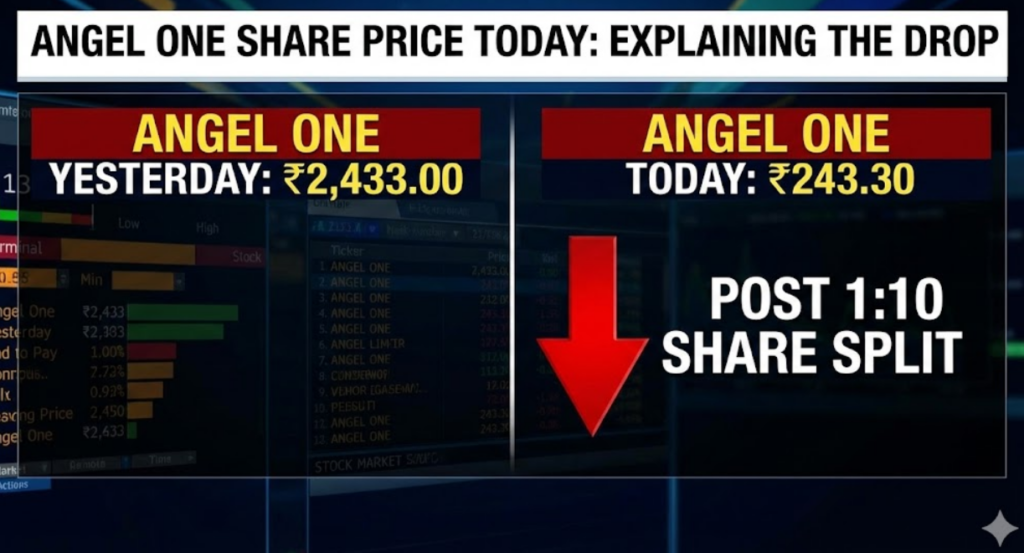
If you hold shares in Angel One, or even if you simply searched for the angel one share price bse or angel one share price nse this morning, you might have experienced a moment of sheer panic. Yesterday, the stock was trading well over the ₹2,400 mark. Today, the ticker displays a price hovering around ₹243.30.
Did the company lose 90% of its value overnight? Absolutely not.
This drastic visual drop is the result of a highly anticipated corporate action. On February 26, 2026, Angel One shares officially adjusted for a 1:10 angel one share split. This means that for every single share an investor held yesterday, they now hold ten shares, with the price divided proportionally. There is absolutely no actual loss in investor value.
This strategic move by angel one limited share price management is designed to increase retail participation. A lower nominal share price makes the stock much more accessible to smaller retail investors who might have been priced out when the stock was trading closer to its 52-week high of ₹3,285.00.
Analyzing Angel One’s Fundamentals and Targets
Beyond the mechanics of the split, the core business of the brokerage remains a focal point for market analysts. Recently, the company reported a 4.5% year-on-year decline in Profit After Tax (PAT) for the quarter ending December 2025 (Q3 FY26), which brought the net profit to ₹268.66 crore. Despite this slight dip in profits, the company continues to declare healthy dividends, recently announcing a dividend of ₹23.00 per share prior to the split.+1

For investors looking at the angel one share price target, the consensus remains cautiously optimistic, tied heavily to the broader financialization of savings in India. As more young Indians utilize the angel one login portal to start their investing journeys, the company’s client acquisition rates remain robust. While retail users often mistakenly type angle one into search engines, the brand recall is undeniable. Furthermore, as investors look to diversify their portfolios, products like the angel one gold etf share price (and similar exchange-traded funds offered on their platform) are seeing increased traction as safe-haven assets amidst global market volatility.
Ultimately, the share price of angel one—or the angel one ltd share price—will depend on how well the company manages its operating margins and retains its massive retail user base in an increasingly competitive discount brokerage industry. Keeping an eye on angel one share news over the coming weeks will be vital as the market fully digests the new post-split pricing structure.
The Backbone of the Market: BSE, CDSL, and Financial Infrastructure
You cannot discuss the surge in retail investing without looking at the companies that provide the actual plumbing for the stock market.
Take the bse share price and the broader trajectory of the bse share, for example. As trading volumes hit record highs in India, the exchanges themselves become incredibly lucrative businesses. Similarly, the cdsl share price is a direct proxy for the growth of Demat accounts in the country. Today, Central Depository Services (India) Ltd (CDSL) was trading around ₹1,288.10, experiencing a slight intraday dip of nearly 2.9%. Despite short-term fluctuations, CDSL remains an incredibly robust company with a return on equity (ROE) of 36.23% and a practically zero-debt balance sheet.
Another major player in the infrastructure space is the Multi Commodity Exchange. Tracking the mcx share price gives investors insight into the trading volumes of commodities like gold, silver, crude oil, and base metals.
It is also worth mentioning the fierce competition in the brokerage space. While Angel One is a publicly listed giant, millions of investors constantly search for the groww share price. However, it is important to clarify that Groww remains an unlisted private entity. Until it launches an Initial Public Offering (IPO), retail investors cannot buy its shares directly on the open market, making listed peers like Angel One the primary way to invest in the discount broking theme.
Taking the Market’s Pulse: Nifty 50 and Sensex Today
Moving away from individual brokers, let us look at the broader market health. Today, February 26, 2026, the nifty 50 and the BSE Sensex opened with a cautious but positive undertone.


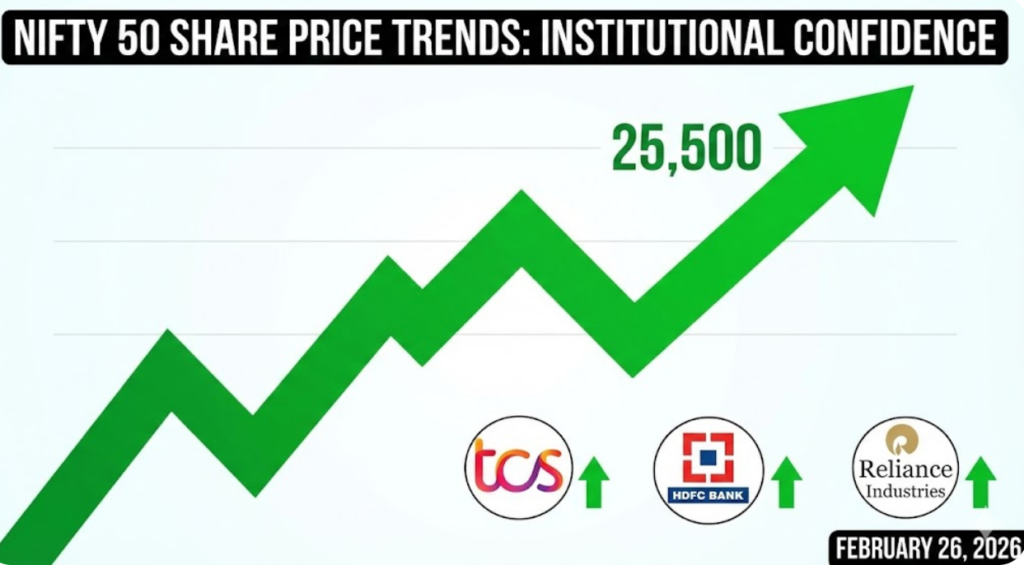
The nifty 50 share price index rose by 0.29% to hit 25,556, while the sensex share price gained over 140 points to reach 82,418.78. For anyone tracking the sensex today, it is clear that the rally is being heavily supported by the banking and IT sectors.
The nifty has been trading in a relatively tight range recently. Analysts note that there is a strong resistance zone for the Nifty 50 between 25,700 and 25,800, where selling pressure tends to emerge. On the downside, immediate support lies around 25,300 to 25,400. The general consensus on Dalal Street is that unless the index decisively breaks above or below these boundaries, the market will remain range-bound, requiring traders to avoid aggressively chasing intraday spikes.+2
Interestingly, the global backdrop is providing some tailwinds. Wall Street recently extended a technology-driven rally, and Asian markets, including Japan’s Nikkei (which surpassed the 59,000 mark for the first time), rose as fears over AI disruptions eased. Furthermore, Foreign Institutional Investors (FIIs) turned net buyers yesterday, injecting ₹2,991.64 crore into the Indian equity markets, complementing the strong support from Domestic Institutional Investors (DIIs).+1
Energy and Renewables: Navigating the Solar Trade War
One of the most intensely debated sectors today is renewable energy. The waaree energies share price has been on a rollercoaster this week. The stock, which traded around ₹2,718.80 today, has been under the spotlight due to major geopolitical developments.
Investors tracking the waaree share price or the broader waaree energies share performance were jolted recently by news that the United States proposed a massive 126% import duty on Indian solar imports. This sent shockwaves through the sector, causing panic selling across solar stocks.
However, today brought a much-needed sigh of relief. Waaree energies share price traded higher in early deals after the company issued a vital clarification regarding the impact of these US tariffs. The company assured investors that the proposed 126% duty is still subject to regulatory proceedings. More importantly, Waaree highlighted that its existing manufacturing capacity located inside the United States will be able to support its ongoing commitments, significantly insulating the business from the brunt of the import tariffs.
This demonstrates the resilience of top-tier Indian renewable companies. When evaluating other energy and power peers—such as the suzlon share price (a leader in wind energy) and the adani power share (a titan in thermal power)—it is evident that India’s insatiable demand for electricity will keep these stocks in the limelight for years to come.
Defence and Railways: The Capital Expenditure Supercycle
If you want to understand where the Indian government is spending its money, look no further than the defence and railway sectors.

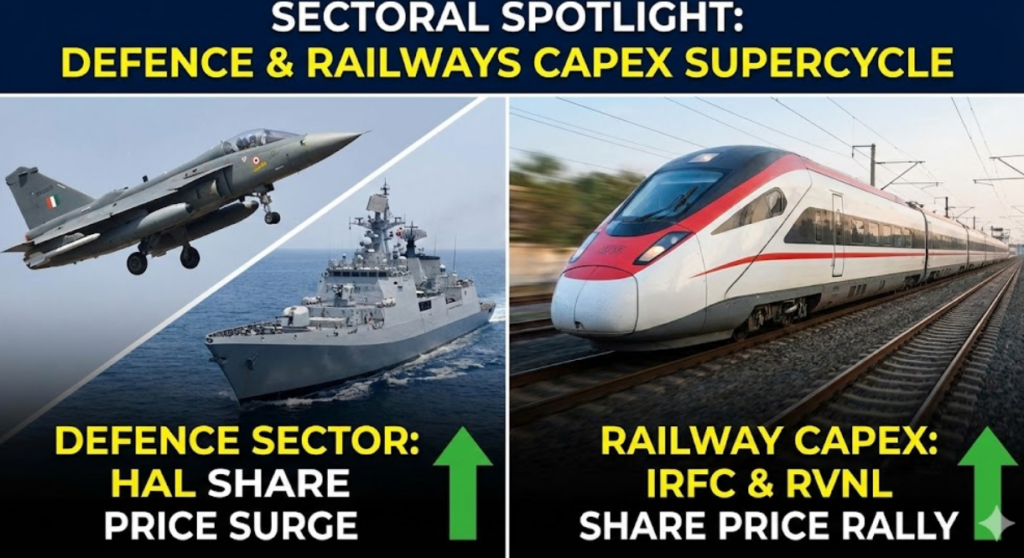
Today, defence stocks were buzzing. The hal share price (Hindustan Aeronautics Ltd) jumped over 0.4% (and up to 5% intraday for the broader defence pack) on the back of news regarding a potential major India-Israel defence deal. Companies like Bharat Electronics and Bharat Dynamics also saw significant upticks. The government’s relentless push for “Atmanirbhar Bharat” (self-reliant India) ensures that domestic order books for these defence contractors remain overflowing.
Similarly, the railway sector continues to be a darling of retail investors. The irfc share price (Indian Railway Finance Corporation) and the irfc share trajectory remain crucial barometers for the sector’s funding capabilities. When paired with the rvnl share price (Rail Vikas Nigam Limited), these stocks reflect the massive, multi-billion dollar capital expenditure cycle dedicated to modernizing India’s railway infrastructure, from Vande Bharat trains to dedicated freight corridors.
Banking and Finance Heavyweights: Navigating Risks and Rewards
No discussion of the Indian stock market is complete without the banking and financial services sector, which essentially dictates the direction of the Bank Nifty.
The hdfc bank share price and the broader hdfc share price metrics remain the undisputed anchors of the index. After the historic merger, the bank’s performance in securing deposits and managing credit growth sets the tone for the entire financial industry. Similarly, the sbi share price reflects the robust health of public sector lending, which has seen vastly improved asset quality and disciplined lending practices over the last few years.
On the non-banking financial company (NBFC) front, the bajaj finance share price (and the general bajaj finance share sentiment) continues to be viewed as a premium consumption proxy. As India’s middle class expands, the demand for consumer durables and personal loans ensures companies like Bajaj Finance maintain their high-growth trajectories.
However, the banking sector is not without its localized shocks. Investors tracking the idfc first bank share price or the idfc share price (including the broader idfc first bank share ecosystem) received concerning news recently. Analysts at BofA Securities noted that a reported ₹529 crore fraud incident presents a near-term risk to the bank’s Current Account Savings Account (CASA) growth due to the potential risk of deposit outflows. While the long-term structural story of the bank may remain intact, such incidents highlight the importance of stringent risk management in the banking sector and often lead to short-term volatility in the stock price.
Technology, Steel, and FMCG: The Old Guard Remains Strong
While AI and renewable energy dominate the headlines, India’s traditional mega-caps continue to provide stability to the Nifty 50.
In the IT sector, the infosys share price and the tcs share price are enjoying a renewed wave of optimism. Nifty IT gained nearly 0.89% today, signaling that global demand for Indian technology services remains highly resilient. Despite global fears regarding artificial intelligence taking over coding jobs, industry leaders are projecting confidence. For instance, management at Tata Consultancy Services (TCS) recently stated publicly that they are “not afraid of AI disrupting livelihoods,” suggesting that AI will act as an enabler rather than a pure replacement for their massive workforces.+2
Moving to heavy industries and commodities, the reliance share price remains a behemoth that influences the entire index, given its massive footprint across petrochemicals, retail, and telecommunications. In the metals space, tracking the vedanta share price (or simply the vedanta share) and the tata steel share price (or tata steel share) requires keeping a close eye on global macroeconomic indicators, particularly demand out of China and fluctuations in the US dollar.
Finally, for investors seeking defensive, dividend-paying stocks, the itc share price remains a staple. Fast-Moving Consumer Goods (FMCG) stocks tend to act as a safe harbor when the broader market experiences volatility, relying on consistent rural and urban consumption patterns regardless of global geopolitical noise.
Conclusion: Investing with Discipline in 2026
As the trading session on February 26, 2026, perfectly illustrates, the stock market is an intricate web of interconnected events. From the technical pricing adjustment of the angel one share price today to the geopolitical tariff debates impacting the waaree energies share price, an investor must constantly synthesize massive amounts of information.
The Nifty 50’s steady hold above the 25,500 mark shows that institutional confidence in the Indian growth story remains deeply entrenched. However, the market consistently rewards discipline over impulse. Whether you are accumulating shares of a high-growth defence contractor or holding onto a stable IT giant, the key is to understand the underlying business fundamentals. Keep track of resistance and support levels, stay updated on corporate actions like splits and dividends, and never let short-term panic dictate your long-term financial journey.
(Disclaimer: The information provided in this article is for educational and informational purposes only and does not constitute financial advice. Always consult with a certified financial advisor or conduct your own thorough research before making investment decisions in the stock market.)