
The Indian stock market is never short of drama, but the trading session on Monday, February 23, 2026, will likely be remembered for its extreme polarization. On one hand, the broader market indices celebrated a massive relief rally driven by global macroeconomic developments. On the other hand, a devastating corporate governance shock wiped out billions of rupees in investor wealth in a single banking counter.
If you are wondering why idfc first bank share is falling so aggressively, or if you are looking to track the nifty 50 share price amidst the current volatility, you are not alone. Millions of retail and institutional investors are currently glued to their screens, analyzing everything from the idfc first bank share price today to the sudden collapse in top-tier IT stocks.
In this comprehensive, deep-dive analysis, we will break down the precise reasons behind the banking sector’s latest crisis, examine the ripple effects across the nifty bank index, and provide a detailed outlook on the major market movers including the hdfc bank share, tcs share price, reliance share price, and more.
The Epicenter of the Crisis: IDFC First Bank
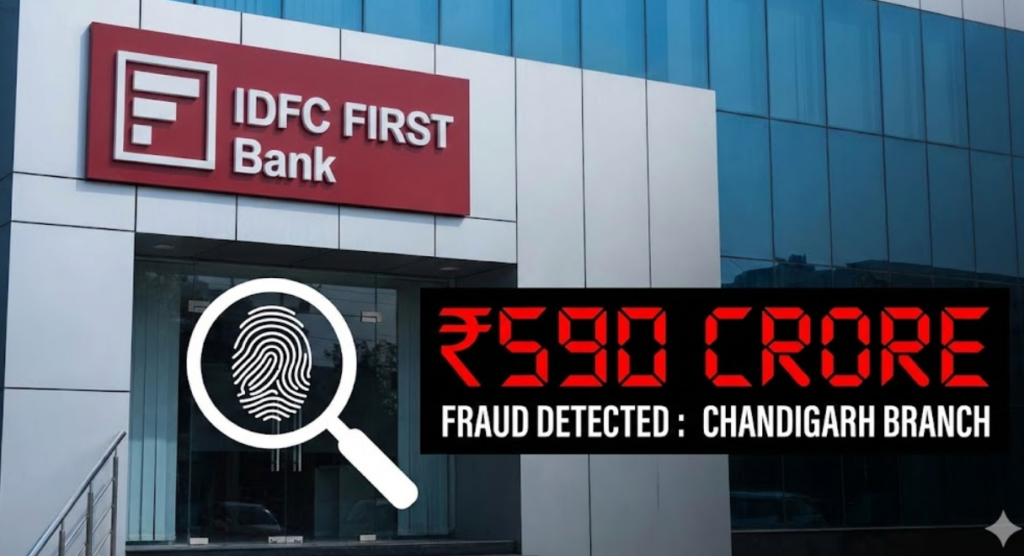
For the past couple of years, IDFC First Bank had been a retail favorite, heavily praised for its customer-centric approach, high interest rates on savings accounts, and rapidly improving asset quality. However, the narrative shifted violently this week. The idfc first bank share news dominating headlines is centered around a massive Rs 590 crore fraud discovered at the bank’s Chandigarh branch.
Breaking Down the Rs 590 Crore Fraud
The trouble officially came to light when the Haryana state government requested the closure of its accounts and the subsequent transfer of funds to another bank. During this reconciliation process, starting around February 18, 2026, glaring discrepancies were spotted between the balances reflected in the bank’s official records and the amounts reported by the state government entities.
The bank released a regulatory filing disclosing that certain employees at its Chandigarh branch were allegedly involved in unauthorized and fraudulent transactions. The bank’s management, led by CEO V. Vaidyanathan, quickly moved to contain the panic, stating that the issue was confined to a specific group of government-linked accounts and was an isolated instance of internal collusion rather than a systemic technological failure. Four suspected officials were immediately suspended, a police complaint was filed, and KPMG was appointed to conduct an independent forensic audit.
For retail depositors frantically logging into the idfc first bank login portal to check their balances, the bank clarified that normal retail accounts remain completely unaffected.
The Impact on the IDFC First Bank Share Price
Despite the management’s reassurances, the stock market’s reaction was swift and merciless. As soon as the market opened, the idfc first bank share price nse and the idfc first bank share price bse plummeted.
The idfc first bank ltd share price hit the dreaded 20% lower circuit, crashing to around Rs 66.85 before finding slight stabilization near the Rs 68.80 – Rs 69.90 mark later in the day. This represents the steepest single-day fall for the idfc share price since the pandemic-induced crash of March 2020.
To put the magnitude of this drop into perspective, the Rs 590 crore fraud actually eclipses the bank’s entire Q3 net profit of Rs 503 crore. The brutal sell-off erased an estimated Rs 14,000 crore to Rs 14,438 crore in total market capitalization in a single trading session. Heavyweight institutional investors bore the brunt of this collapse; the Government of India and the Life Insurance Corporation (LIC) suffered combined notional mark-to-market losses of approximately Rs 1,452 crore.
When tracking the share price idfc first bank or the idfc bank share price, it is crucial to recognize that the reputational damage may linger. Brokerages like Investec maintained a Buy rating but subsequently slashed their idfc first bank share price target from Rs 105 down to Rs 92, noting that the final financial hit will depend on how much money can be recovered. Meanwhile, investors tracking the share price of idfc first bank and the idfc first share price will have to wait for the forensic audit’s findings before true price discovery can resume.
The Contagion Effect: AU Small Finance Bank and Peer Performance
When a governance issue strikes a private lender, the shockwaves usually ripple through the nifty bank index. In this particular case, the fallout directly impacted another major player: AU Small Finance Bank.
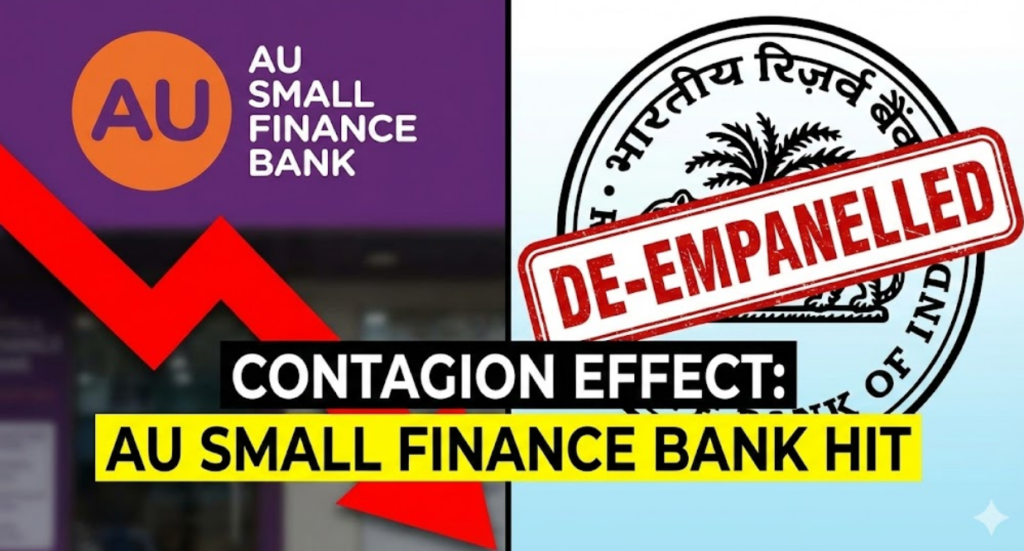
Following the discovery of the fraud, the Haryana government made the drastic decision to de-empanel both IDFC First Bank and AU Small Finance Bank, directing all state government departments to close their accounts with these lenders immediately.
As a direct consequence of this de-empanelment news, the au small finance bank share price took a significant hit. The au bank share price (or au small finance bank share as it is often searched) slid between 3.5% and 6.4%, with the stock trading in the red around the Rs 962 to Rs 993 range on Monday. Despite this short-term setback, long-term investors tracking au small finance bank note that it fundamentally remains a strong entity, though the loss of state government business creates an undeniable near-term overhang.
Stability in the Giants: HDFC, SBI, and Others
While mid-tier banks faced extreme volatility, the foundational pillars of the nifty bank provided much-needed stability to the financial sector.
- HDFC Bank: The hdfc bank share price remained relatively steady, trading around the Rs 911 to Rs 916 mark. As the heaviest weight in the banking index, stability in the hdfc bank share is absolutely critical to prevent broader market panics.
- State Bank of India (SBI): The public sector behemoth showed resilience, with the sbi bank share price (often tracked as sbi share price) trading in the green at roughly Rs 1,216 to Rs 1,222.
- Yes Bank: Investors constantly monitor the yes bank share price for turnaround signals. On Monday, the yes bank share traded relatively flat, hovering around Rs 21.00, mostly insulated from the specific corporate governance issues plaguing IDFC First.
- Other Public Sector Lenders: Other notable PSU bank stocks like the indian bank share price, canara bank share, and pnb share also saw positive momentum as the broader Nifty PSU Bank index gained over 1.5% during recent sessions.
Broader Market Dynamics: Sensex Today and the Nifty 50
Despite the catastrophic idfc first bank news, the broader Indian equity markets showcased a remarkable decoupling on Monday. If you are tracking the nifty 50 or the sensex today, you would see a sea of green.
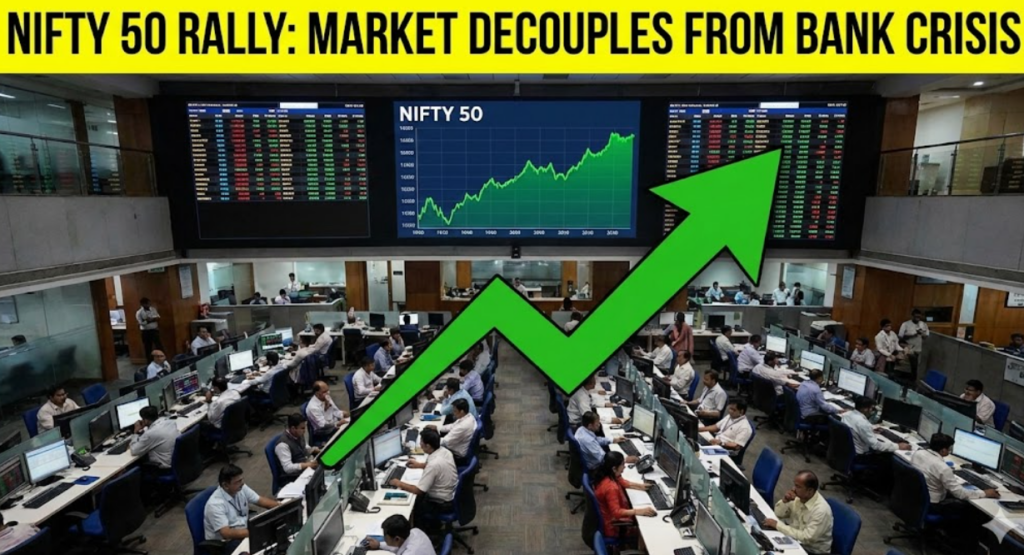
The nifty opened strong and maintained its upward trajectory. At the time of reporting, the nifty share price (representing the Nifty 50 index level) advanced by over 149 points, comfortably crossing the crucial 25,700 mark to trade at 25,720. Concurrently, the sensex surged by more than 500 to 600 points, breaching the 83,300 level. The overall bse share price index trends reflected a clear “risk-on” environment.
Global Cues and the US Tariff Drama
The primary catalyst for this massive market recovery was international. Markets had been heavily pressured by geopolitical tensions and trade war fears. However, over the weekend, the US Supreme Court struck down President Donald Trump’s sweeping tariffs that had been imposed under an economic emergency law.
While Trump quickly retaliated by announcing a new 10% blanket tariff via a separate legal route (subsequently raising it to 15%), the immediate removal of the original draconian emergency tariffs provided a massive sigh of relief to global equities. Wall Street futures rallied, and Indian markets, reacting to the positive Gift Nifty cues, opened with strong bullish momentum.
The IT Sector Bloodbath: The AI Threat Claims its Victims
While banks and broader indices dominated the headlines, a silent crisis has been unfolding in India’s cornerstone Information Technology sector. The narrative that Artificial Intelligence (AI) will cannibalize traditional IT service revenues is no longer just a theory; it is violently pricing itself into the market.
TCS Plunges to a 5-Year Low
The most shocking casualty of this trend is Tata Consultancy Services. The tcs share price recently tumbled a staggering 44% from its all-time high of Rs 4,592 (reached in August 2024), crashing to Rs 2,585. This is the lowest the stock has traded since September 2020. The market capitalization of India’s premier IT firm slipped to Rs 9.60 lakh crore. Brokerages highlight that rapid advancements in AI platforms (like Anthropic’s Claude and OpenAI’s models) are leading clients to reconsider massive, traditional IT outsourcing contracts, directly hitting TCS’s future revenue visibility.
Infosys and Wipro Dragged Down
This AI-driven sell-off is a sector-wide phenomenon. The infosys share price has also felt the heat, trading lower around the Rs 1,353 mark as the entire Nifty IT index continues to suffer consecutive weeks of losses. Similarly, the wipro share price has been caught in the crossfire, with Wipro ADRs falling sharply in US overnight trading. For retail investors holding the infosys share or wipro share, the immediate future looks volatile as these legacy companies scramble to pivot their business models toward generative AI consulting.
Tracking the Heavyweights: Core Portfolio Stocks in 2026
Beyond the banks and the tech sector, several other major blue-chip and high-momentum stocks are dictating the flow of the nifty 50.
- Reliance Industries: Often considered the ultimate bellwether of the Indian market, the reliance share price has been a pillar of support. Driven by its diverse energy and retail portfolios, the stock was trading positively around Rs 1,419 to Rs 1,425, helping offset the losses in the IT sector.
- Tata Steel: The metals sector has seen renewed buying interest. The tata steel share price is currently hovering around Rs 209 to Rs 210. Top brokerages like Motilal Oswal maintain a ‘Buy’ recommendation on the tata steel share for long-term holding, citing a target price of Rs 240, implying a potential upside of 14%.
- Tata Motors: The automotive giant continues its steady run. The tata motors share gained nearly 1% during Monday’s session, trading strong at Rs 378 to Rs 381.
- ITC: A favorite among dividend investors, the itc share price remained relatively flat, trading in a tight consolidation zone around Rs 326 to Rs 327.
- Jio Financial Services: The newly minted financial arm of the Reliance empire is closely watched by retail traders. The jio share price saw minor fluctuations, trading near the Rs 258 to Rs 260 levels.
- Suzlon Energy: In the renewable energy space, the suzlon share price continues to attract massive retail volumes. The stock traded marginally in the green at Rs 44.56, recovering from historical lows as India aggressively expands its wind energy capacity.
- UPL Limited: On the losing end, the upl share price took a severe beating alongside IDFC First Bank, crashing over 12% to Rs 658, making it one of the top losers of the day.
Conclusion: Navigating the Chaos
For the modern investor, the events of February 23, 2026, serve as a masterclass in market dynamics. The simultaneous occurrence of the idfc first bank ltd share crash and the nifty breakout perfectly illustrates that the stock market is not a single organism, but a complex ecosystem of deeply disconnected narratives.
If you are a shareholder looking at your portfolio’s idfc first bank share price today, the key takeaway is patience. While a Rs 590 crore fraud is a massive governance failure, the bank’s underlying capital adequacy remains largely intact, and the financial impact—though painful—is mathematically manageable relative to its total balance sheet.
However, whether you are buying the dip on the idfc bank share price, betting on a turnaround in the tcs share price, or simply riding the broader wave of the sensex today, risk management remains paramount. Diversification is your only true defense against the sudden, unpredictable shocks that define Dalal Street.